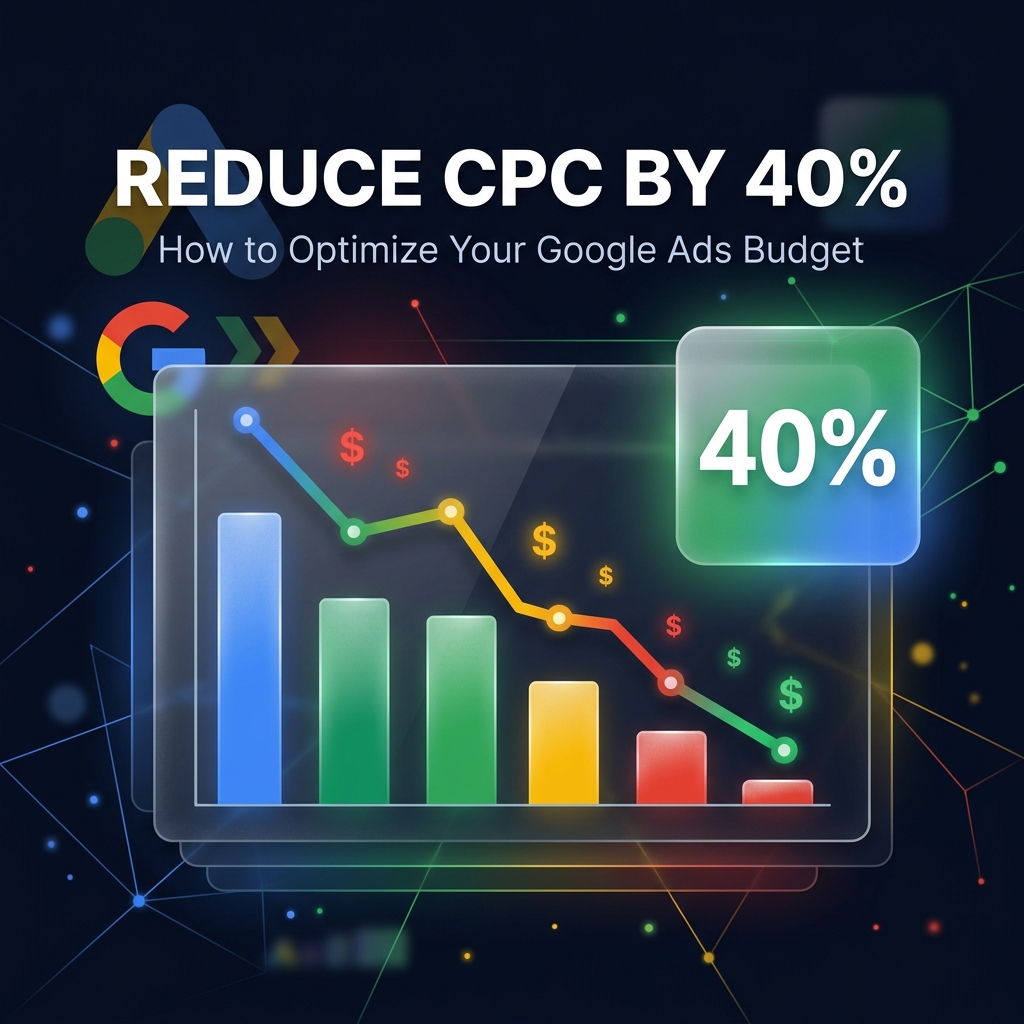
Your Google Ads CPC is too high — and you’re probably paying 30–50% more per click than you need to. The difference between a ₹15 CPC and a ₹9 CPC across 1,000 daily clicks is ₹1,80,000 wasted per month. At Grothify, our Google Ads management services have consistently reduced client CPCs by 35–55% while increasing conversion volume.
This guide reveals the exact 10-step playbook we use. No theory — just the specific actions that move the CPC needle.
Get a Free Google Ads CPC Audit
We’ll analyze your account and show you exactly where you’re overpaying — with specific fixes for each campaign.
Why Is Your Google Ads CPC So High?
Before we fix the problem, let’s understand why it exists. Google Ads uses a real-time auction system where your actual CPC is determined by three factors:
| Factor | What It Measures | Impact on CPC |
|---|---|---|
| Quality Score | Ad relevance, landing page experience, expected CTR | Low QS = pay 400% more per click |
| Ad Rank | Quality Score × Max Bid | Higher Ad Rank = lower actual CPC |
| Competition | How many advertisers bid on the same keyword | More bidders = higher floor price |
The key insight: Quality Score is the multiplier. An advertiser with a Quality Score of 9 pays roughly 50% less per click than an advertiser with a Quality Score of 5 — for the exact same keyword and position.
The 10-Step CPC Reduction Playbook
Strategy 1: Improve Quality Score from 5 to 8+ (Expected Savings: 30–50%)
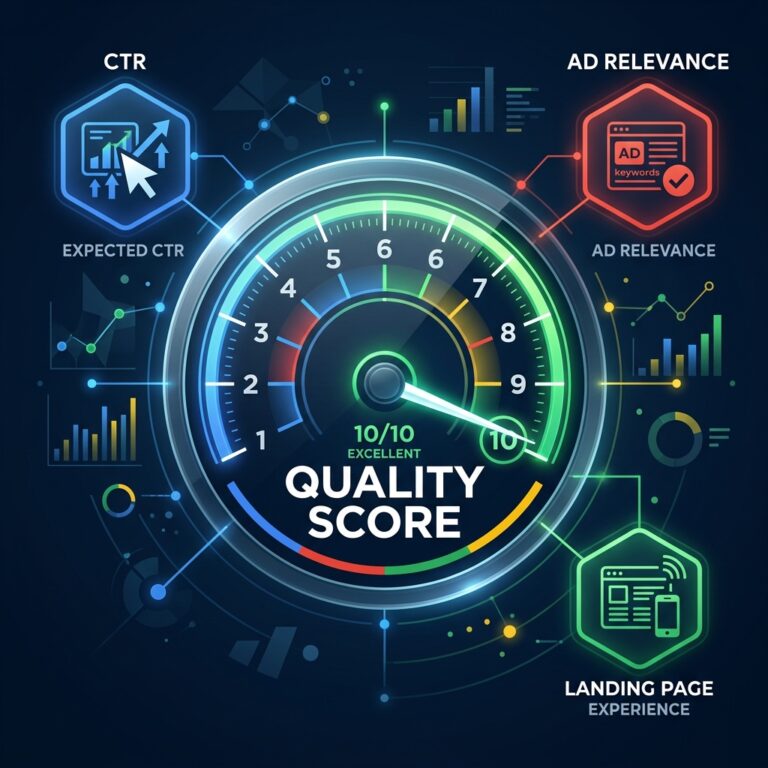
Quality Score is graded 1–10 for each keyword and has three components:
- Expected CTR — How likely users are to click your ad (vs. competitors)
- Ad Relevance — How closely your ad copy matches the search query
- Landing Page Experience — How relevant and fast your landing page is
Action steps:
- Check Quality Score for every keyword in your account (Columns → Modify → Quality Score)
- Any keyword below 6 needs immediate attention
- Improve each component individually — don’t guess which one is dragging you down
Strategy 2: Tighten Keyword Match Types
Broad match keywords bleed money by triggering ads for irrelevant searches. Move from broad match to phrase match or exact match for your highest-spend keywords.
Example:
- ❌ Broad:
digital marketing→ triggers for “digital marketing salary”, “digital marketing memes” - ✅ Phrase:
"digital marketing agency"→ triggers for “best digital marketing agency near me” - ✅ Exact:
[digital marketing agency hyderabad]→ triggers only for that exact intent
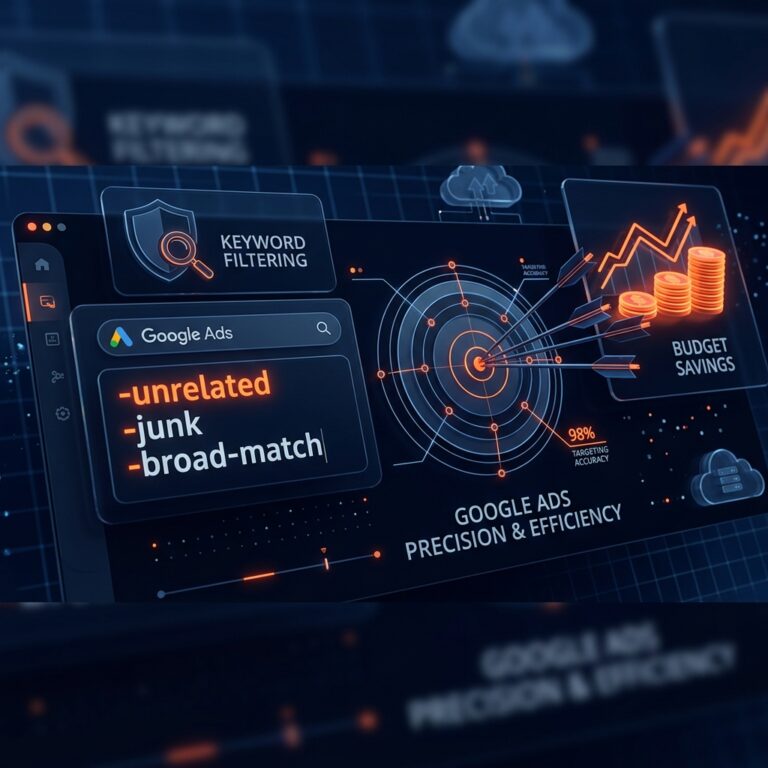
Strategy 3: Build a Negative Keyword List (Weekly)
This is the most neglected CPC reduction tactic. Every week, review your Search Terms Report and add irrelevant queries as negative keywords.
Common negative keywords every service business needs:
- “free”, “salary”, “jobs”, “internship”, “course”, “tutorial” (if you’re selling services, not education)
- “download”, “template”, “PDF” (unless you’re offering lead magnets)
- Competitor brand names you don’t want to compete with
- Geographic locations you don’t serve
A well-maintained negative keyword list can reduce wasted spend by 15–25% within the first month.
Strategy 4: Write Hyper-Relevant Ad Copy (Match Intent Exactly)
Your ad copy must mirror the exact language of the search query. This improves both CTR and Ad Relevance Score simultaneously.
Framework for high-relevance RSA headlines:
- Headline 1: Include the exact keyword — “Professional SEO Services”
- Headline 2: Your unique value proposition — “180% Organic Traffic Growth”
- Headline 3: Proof or urgency — “100+ Brands Trust Grothify”
Write at least 15 unique headlines per RSA (Google tests combinations) and 4 descriptions. Pin your highest-performing headline to Position 1.
Strategy 5: Use Single Keyword Ad Groups (SKAGs) for Top Spenders
For your top 10 highest-spending keywords, create dedicated ad groups with just that one keyword. This lets you write perfectly matched ad copy and landing pages, dramatically improving Quality Score.
Structure:
- Ad Group: “SEO Services” → Keyword:
[seo services]→ Ad: tailored specifically to “SEO Services” → Landing page: /seo-services/ - Ad Group: “Google Ads Agency” → Keyword:
[google ads agency]→ Ad: tailored to “Google Ads Agency” → Landing page: /google-ads-services/
Strategy 6: Optimize Landing Page Speed & Relevance
Google measures your landing page experience as part of Quality Score. A slow, irrelevant landing page directly increases your CPC.
Landing page checklist:
- Page loads in under 2.5 seconds on mobile (test on PageSpeed Insights)
- H1 heading contains the keyword from the ad group
- Clear call-to-action above the fold
- No pop-ups or intrusive interstitials on mobile
- Content directly addresses the user’s search intent
Strategy 7: Daypart Your Campaigns (Ad Scheduling)
Not all hours convert equally. If your data shows that conversions happen mostly between 9 AM–7 PM on weekdays, reduce bids by 20–30% during off-hours or pause entirely overnight.
How to check: Go to Campaigns → Ad schedule → Day and hour report. Look for time slots with high spend but zero conversions.
Strategy 8: Use Target CPA or Maximize Conversions (Smart Bidding)
Once you have 30+ conversions in the last 30 days, switch from manual CPC to Target CPA bidding. Google’s machine learning will automatically adjust bids to find the cheapest conversions.
| Bidding Strategy | When to Use | Expected Result |
|---|---|---|
| Manual CPC | New campaigns, under 15 conversions/month | Full control, higher CPC |
| Maximize Clicks | Building data, need traffic volume | Low CPC, variable quality |
| Target CPA | 30+ conversions/month, clear CPA goal | Lowest cost-per-conversion |
| Target ROAS | E-commerce with revenue tracking | Maximum revenue per spend |
Strategy 9: Geo-Target Precisely
If you’re a service business, don’t target “India” broadly. Target the specific cities and regions where your actual customers are. This eliminates clicks from irrelevant locations that inflate CPC without generating revenue.
Important setting: Change location targeting from “People in, or who show interest in” to “People in or regularly in”. This prevents your ads from showing to people who are merely researching your target location.
Strategy 10: Review & Kill Low-Performing Keywords Monthly
Every month, pause keywords that have:
- Spent more than 2x your target CPA without a conversion
- Quality Score below 4 (these keywords are costing you a premium)
- CTR below 2% consistently (low relevance signal)
Reallocate that budget to your top-performing keywords. Concentration beats diversification in PPC.
Real Results: CPC Reduction Case Study
Here’s what happened when we applied this playbook to a B2B client’s Google Ads account at Grothify:
| Metric | Before Optimization | After 30 Days | Change |
|---|---|---|---|
| Average CPC | ₹42 | ₹18 | -57% |
| Quality Score (avg) | 4.2 | 7.8 | +86% |
| Click-Through Rate | 2.1% | 6.4% | +205% |
| Cost per Conversion | ₹1,200 | ₹520 | -57% |
| Conversions/Month | 23 | 61 | +165% |
The total ad spend actually decreased by 18% while conversions nearly tripled. That’s the power of CPC optimization — you spend less and get more.
Overpaying on Google Ads? Let’s Fix It.
Grothify’s PPC team will audit your campaigns, identify wasted spend, and implement these exact strategies. Average client saves 40% on CPC.
Frequently Asked Questions About Google Ads CPC
What is a good CPC for Google Ads in India?
A good CPC in India varies by industry: B2B services typically see ₹15–₹60 CPC, e-commerce ₹5–₹25 CPC, education ₹8–₹35 CPC, and real estate ₹20–₹80 CPC. The key metric isn’t the CPC itself but the cost per conversion. A ₹50 CPC that converts at 10% (₹500/conversion) is better than a ₹10 CPC that converts at 1% (₹1,000/conversion). Focus on conversion efficiency, not just click cost.
How does Quality Score affect CPC?
Quality Score directly determines how much you pay per click. Google rewards high Quality Score with discounted CPCs. A keyword with Quality Score 10 pays roughly 50% less than the same keyword with Quality Score 5. The formula: Actual CPC = (Ad Rank of the advertiser below you ÷ Your Quality Score) + ₹0.01. So higher Quality Score = lower denominator = lower CPC.
Should I use broad match or exact match keywords?
Start with exact match and phrase match for controlled spending and clear data. Once you have conversion tracking set up and 30+ conversions/month, you can test broad match with Smart Bidding (Target CPA) — Google’s AI will handle the relevance filtering. Never use broad match with manual bidding — it bleeds budget on irrelevant queries. Read our full Google Ads vs Meta Ads comparison for more strategy context.
How quickly can I reduce my Google Ads CPC?
Negative keyword cleanup and ad copy improvements can reduce CPC within 7–14 days. Quality Score improvements take 2–4 weeks to reflect as Google reassesses your metrics. Landing page speed improvements show impact within one re-crawl cycle (1–3 days). Overall, most accounts see a measurable CPC reduction within the first 30 days of systematic optimization.
Is it worth hiring a Google Ads agency to manage CPC?
If your monthly ad spend exceeds ₹50,000, yes — absolutely. A professional Google Ads management agency like Grothify typically saves clients 30–50% on CPC while increasing conversions. The management fee pays for itself many times over through reduced wasted spend, better Quality Scores, and higher conversion rates. The ROI is almost always positive within the first month.
Written by Mohammed Ouzair, Founder & Google Ads Specialist at Grothify. This guide is part of our Google Ads management services. Follow us on Instagram and LinkedIn for daily PPC tips and campaign strategies.