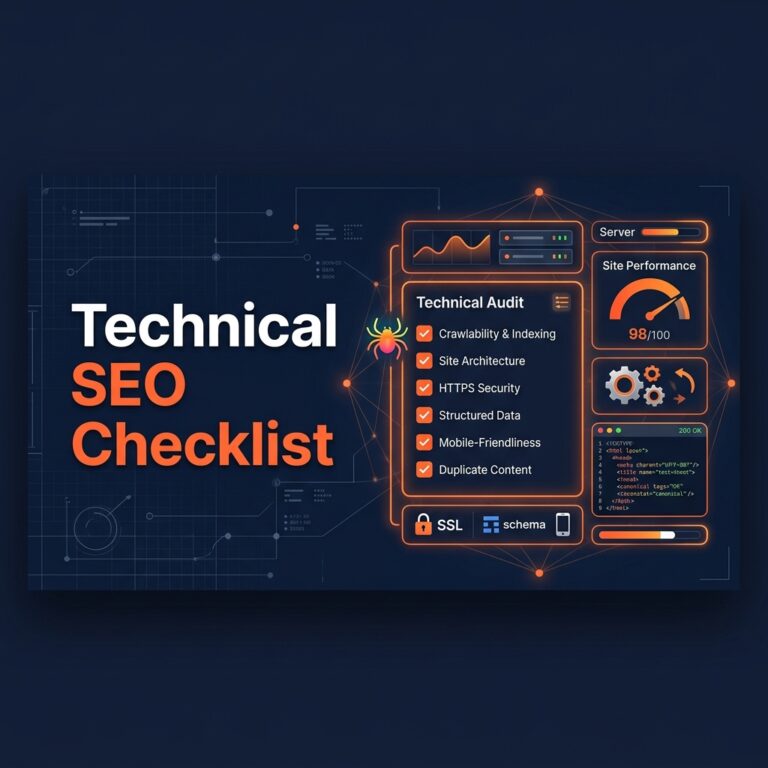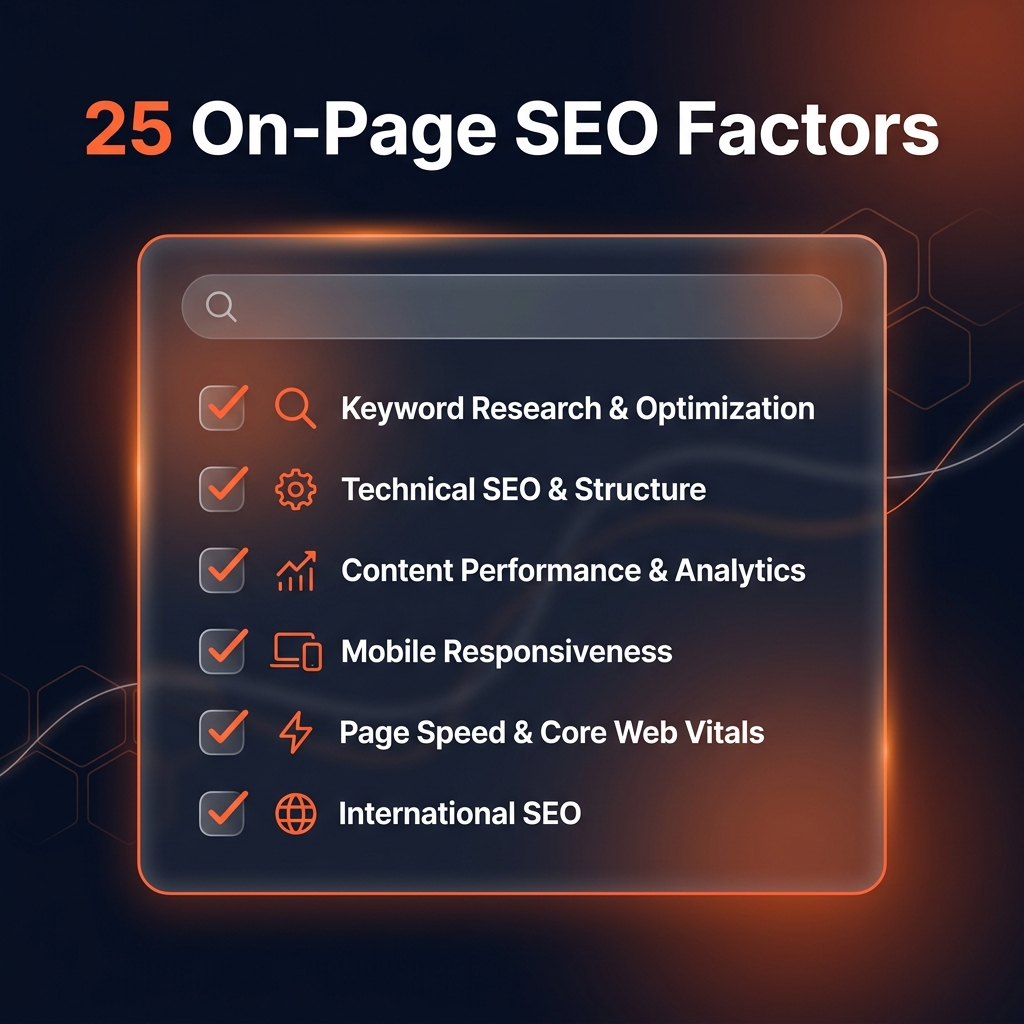
On-page SEO is the single most controllable ranking factor you have. Unlike backlinks or domain authority that take months to build, on-page optimization delivers results within days of Google’s next crawl. Yet most websites get fewer than 10 of these 25 factors right.
This checklist is the exact framework we use at Grothify’s SEO services to audit and optimize every client website. It’s helped deliver 180% average organic traffic growth across 100+ brands. Bookmark this page — you’ll come back to it before publishing every piece of content.
Want Us to Run This Checklist On Your Site?
Get a free on-page SEO audit from Grothify — we’ll score every page and show you exactly what to fix.
Section 1: Title Tag & Meta Description (Factors 1–4)
✅ 1. Title Tag Contains Primary Keyword (First 60 Characters)
Your title tag is the single most important on-page ranking signal. Google uses it to understand what your page is about, and it’s the blue clickable text users see in search results.
How to optimize:
- Place your primary keyword as close to the beginning as possible
- Keep the total length under 60 characters (Google truncates after this)
- Add a hook or modifier: [2026], [Free], [Step-by-Step], [Checklist]
- Include your brand name at the end separated by a pipe:
| Grothify
Bad: Welcome to Our Blog | Grothify
Good: On-Page SEO Checklist 2026: 25 Ranking Factors [Free Template] | Grothify
✅ 2. Meta Description Is Compelling & Under 155 Characters
Meta descriptions don’t directly affect rankings, but they massively impact click-through rate (CTR) — which does affect rankings. A well-written meta description can increase clicks by 30–40% compared to Google’s auto-generated snippet.
Formula: [What the article covers] + [Proof/credibility] + [Call to action]
Example: “25 proven on-page SEO factors with step-by-step instructions. Used by Grothify for 100+ client sites. Free downloadable checklist included.”
✅ 3. URL Slug Is Short, Clean & Contains Keyword
Google reads your URL structure. Keep slugs short, lowercase, hyphen-separated, and keyword-relevant.
Bad: /blog/2026/08/07/the-ultimate-complete-on-page-seo-optimization-checklist-for-2026
Good: /on-page-seo-checklist/
✅ 4. Only ONE H1 Tag Per Page
Your H1 is your page’s headline. Google expects exactly one H1 per page, and it should contain or closely match your primary keyword.
- Every page must have exactly one H1 tag
- The H1 should match the search intent of your target keyword
- Don’t repeat the exact title tag — make the H1 slightly more descriptive
Section 2: Content Quality & Structure (Factors 5–12)
✅ 5. Content Directly Answers the Search Query in the First 2 Sentences
Google’s featured snippet algorithm pulls direct answers from the first paragraph. If your opening paragraph doesn’t directly address the user’s search intent, you lose both the snippet opportunity and impatient visitors.
Rule: Your first two sentences should directly answer the question implied by your target keyword. Then expand with context and detail.
✅ 6. Proper H2/H3 Heading Hierarchy
Search engines use heading structure to understand your content’s organization. Think of it like a table of contents:
- H1 — Page title (one per page)
- H2 — Major sections (target secondary keywords)
- H3 — Sub-sections within each H2
- Never skip levels (don’t jump from H2 to H4)
✅ 7. Content Length Matches Competitor Benchmarks
There’s no magic word count, but your content should be at least as comprehensive as the current top 3 results for your keyword. In most competitive niches, this means:
| Content Type | Recommended Length | Example |
|---|---|---|
| Blog Post | 1,500 – 2,500 words | How-to guides, listicles |
| Pillar Page | 2,500 – 5,000 words | Service pages, ultimate guides |
| Product/Landing Page | 800 – 1,500 words | Sales pages, comparisons |
| FAQ Page | 500 – 1,200 words | Support, knowledge base |
✅ 8. Keyword Density Is Natural (1–2%)
Include your primary keyword 3–5 times naturally throughout the content. Use semantic variations and related terms instead of repeating the exact same phrase. Google’s NLP understands synonyms — “on-page SEO”, “on-site optimization”, and “page-level ranking factors” all reinforce the same topic.
✅ 9. Content Includes Tables, Lists & Visual Elements
Google loves structured content. Pages with tables, ordered lists, and bullet points are 3x more likely to win featured snippets. They also improve readability and reduce bounce rate.
Every article should include at least:
- 1 comparison table
- 2–3 bulleted or numbered lists
- 1 CTA banner or callout box
✅ 10. Content Has Original Data, Screenshots, or Examples
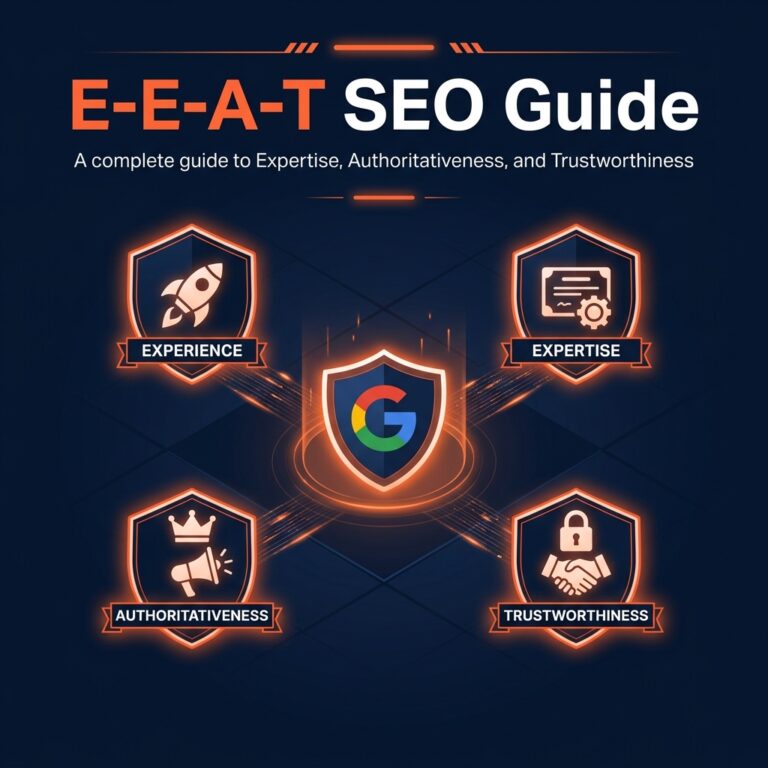
Generic content gets generic rankings. The articles that consistently rank #1 include original proof: campaign screenshots, real metrics, case study data, or unique frameworks. This is the core principle behind Google’s E-E-A-T (Experience, Expertise, Authoritativeness, Trustworthiness).
✅ 11. FAQ Section at the Bottom of Every Post
Adding an FAQ section does two things:
- Captures long-tail “People Also Ask” queries directly on your page
- Qualifies for FAQ rich results in Google (when paired with FAQPage schema), increasing your SERP real estate by 30–40%
Every blog post should end with 4–6 frequently asked questions using <h3> for questions and <p> for answers.
✅ 12. Author Byline with Credentials
Google’s Helpful Content System rewards content written by demonstrable experts. Include an author byline at the bottom of every post with name, title, credentials, and social links. This reinforces E-E-A-T and builds brand recognition.
Section 3: Internal & External Linking (Factors 13–17)
✅ 13. 3–5 Internal Links to Related Pages
Internal links are the most underrated SEO tactic. They distribute authority across your site and help Google discover new pages. Every article should link to:
- Its pillar page (e.g., this article links to our SEO services pillar)
- 2–3 related blog posts with keyword-rich anchor text
- Relevant service or product pages
✅ 14. Keyword-Rich Anchor Text for Internal Links
Bad: “Click here to learn about SEO.”
Good: “Learn more in our complete SEO guide for small businesses.”
Use descriptive, keyword-containing anchor text for internal links. This tells Google what the linked page is about.
✅ 15. 1–2 External Links to Authoritative Sources
Linking out to trusted sources (Google’s documentation, research papers, industry reports) signals that your content is well-researched. Don’t be afraid to link externally — it builds trust, not competition.
✅ 16. All Links Open Correctly (No Broken Links)
Broken internal links waste crawl budget and create poor user experience. Run a link check before publishing and audit existing content monthly.
✅ 17. External Links Use rel="noopener" and target="_blank"
External links should open in a new tab so visitors don’t leave your site. Always add rel="noopener" for security and target="_blank" for UX.
Section 4: Images & Media (Factors 18–21)
✅ 18. All Images Have Descriptive Alt Text
Alt text tells Google (and screen readers) what an image contains. Write natural descriptions that include keywords where relevant:
Bad: alt="image1" or alt=""
Good: alt="On-page SEO checklist showing title tag optimization in Google Search Console"
✅ 19. Images Are WebP Format (Under 100KB)
Large images are the #1 cause of slow page loads. Convert all images to WebP format and compress to under 100KB. Use tools like Squoosh, ShortPixel, or Imagify.
✅ 20. Images Have Explicit Width & Height Attributes
Missing width and height attributes cause Cumulative Layout Shift (CLS) — a Core Web Vital metric. Always specify dimensions so the browser reserves space before the image loads.
✅ 21. Featured Image Is 1200px+ Wide (Google Discover Requirement)
Google Discover requires images at least 1200 pixels wide to display as large preview cards. Combined with the max-image-preview:large meta tag, this can drive thousands of additional impressions from Google Discover feeds.
Section 5: Technical & Schema (Factors 22–25)
✅ 22. Page Loads in Under 2.5 Seconds (LCP)
Largest Contentful Paint (LCP) is Google’s primary speed metric. If your page takes longer than 2.5 seconds to render its main content, you’re losing both rankings and visitors. At Grothify, we’ve reduced client LCP from 6+ seconds to under 2 seconds through our technical SEO services.
✅ 23. Mobile-Responsive Design
Google uses mobile-first indexing — meaning Google ranks your site based on how it performs on mobile, not desktop. Test every page on mobile devices and ensure text is readable, buttons are tappable, and layouts don’t break.
✅ 24. FAQPage Schema Markup on FAQ Sections
If your page has an FAQ section, add FAQPage structured data so Google can display your questions and answers directly in search results as rich snippets. This dramatically increases your SERP visibility and click-through rate.
✅ 25. Canonical URL Is Set Correctly
Every page should have a <link rel="canonical"> tag pointing to itself (or to the preferred version if duplicates exist). This prevents duplicate content issues and consolidates ranking signals.
Need Help Implementing This Checklist?
Grothify’s SEO team will audit your site against all 25 factors and implement every fix. Book a free strategy call with Mohammed Ouzair.
Frequently Asked Questions About On-Page SEO
What is on-page SEO?
On-page SEO refers to all optimizations you make directly on your website pages to improve search engine rankings. This includes title tags, meta descriptions, heading structure, content quality, internal linking, image optimization, page speed, and structured data markup. Unlike off-page SEO (backlinks), on-page SEO is entirely within your control and delivers the fastest results.
How many keywords should I target per page?
Each page should target one primary keyword and 2–3 closely related secondary keywords. Trying to rank one page for unrelated keywords dilutes its focus and confuses search engines. Use topic clusters to create separate pages for each distinct keyword group.
How often should I update my on-page SEO?
Review and refresh your on-page SEO every 4–6 weeks. Update statistics and year references, add new FAQ questions based on “People Also Ask” data from Google Search Console, improve internal links to newly published content, and re-optimize titles if click-through rates are below average. Content freshness is a confirmed Google ranking signal.
Does on-page SEO matter more than backlinks?
Both matter, but on-page SEO is the foundation. Without solid on-page optimization, even hundreds of backlinks won’t help you rank. Think of it this way: on-page SEO makes your page eligible to rank, while backlinks determine how high you rank among eligible pages. Start with perfect on-page optimization, then build authority through professional SEO services that include link building.
What is the most important on-page SEO factor in 2026?
In 2026, search intent alignment is the most important on-page factor. Google’s AI (including the Helpful Content System) is extremely good at understanding whether your page actually answers what the searcher was looking for. If your content perfectly matches the user’s intent — informational, commercial, transactional, or navigational — technical factors like keyword placement become secondary. Write for humans first, then optimize for search engines.
Written by Mohammed Ouzair, Founder & SEO Specialist at Grothify. This checklist is part of our comprehensive SEO services. Follow us on Instagram and LinkedIn for daily SEO tips and digital marketing strategies.