Every business owner in 2026 faces the same million-dollar question: Where should I spend my advertising budget – Google Ads or Meta Ads?
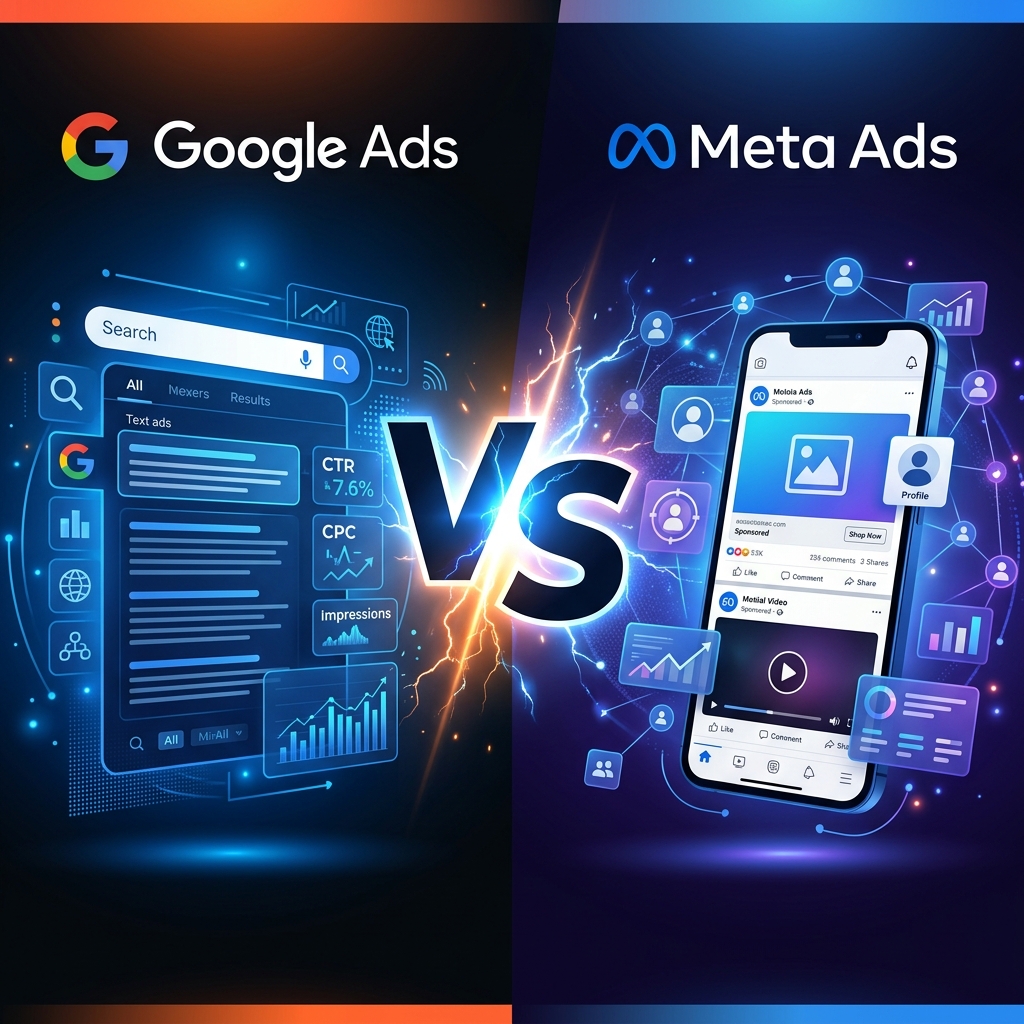
Both platforms dominate the digital advertising landscape, but they work in fundamentally different ways. Google Ads captures people who are actively searching for your product. Meta Ads (Facebook & Instagram) finds people who fit your ideal customer profile – even if they don’t know they need you yet.
In this comprehensive guide, we’ll break down the strengths, weaknesses, costs, and best use cases for each platform, so you can make a data-driven decision that maximizes your ROI.
What Are Google Ads?
Google Ads (formerly Google AdWords) is the world’s largest pay-per-click advertising platform. Your ads appear when someone searches for a specific keyword on Google, browses websites in the Google Display Network, watches YouTube, or uses Google Shopping.
Key Ad Types:
- Search Ads – Text ads that appear at the top of Google search results
- Display Ads – Visual banner ads shown across 2M+ partner websites
- Shopping Ads – Product listings with images, prices, and reviews
- YouTube Ads – Video ads before, during, or after YouTube content
- Performance Max (PMax) – AI-powered ads across all Google channels
Why businesses love Google Ads: You’re reaching people with high purchase intent. Someone searching “buy running shoes online” is much closer to buying than someone scrolling Instagram.
What Are Meta Ads?
Meta Ads run across Facebook, Instagram, Messenger, and the Audience Network. Instead of targeting search keywords, Meta Ads target people based on their demographics, interests, behaviours, and online activity.
Key Ad Types:
- Image Ads – Single image posts in feeds and stories
- Video Ads – Short-form video content in Reels, Stories, and Feed
- Carousel Ads – Multiple scrollable images/videos in one ad
- Collection Ads – Immersive mobile shopping experiences
- Lead Generation Ads – In-app forms that capture leads without leaving the platform
- Advantage+ Shopping – AI-automated campaigns for e-commerce
Why businesses love Meta Ads: You can reach a hyper-specific audience based on interests, behaviours, and lookalike audiences – even before they know they need your product.
Head-to-Head Comparison: Google Ads vs Meta Ads in 2026
Here’s how the two platforms compare across the metrics that matter most:
| Feature | Google Ads | Meta Ads |
|---|---|---|
| User Intent | High (active search) | Low-Medium (passive discovery) |
| Targeting | Keywords, location, device | Demographics, interests, behaviours, lookalikes |
| Average CPC | INR 20-INR 200+ | INR 5-INR 50 |
| Best For | Lead gen, e-commerce, local services | Brand awareness, engagement, D2C brands |
| Ad Formats | Text, shopping, display, video | Image, video, carousel, stories, reels |
| Audience Size | 8.5B+ daily searches | 3.05B monthly active users |
| Retargeting | Strong (Display + Search) | Excellent (Pixel-based) |
| ROI Timeline | Immediate (search) | 1-2 weeks (algorithm learning) |
| AI Features | Performance Max, Smart Bidding | Advantage+, Automated Rules |
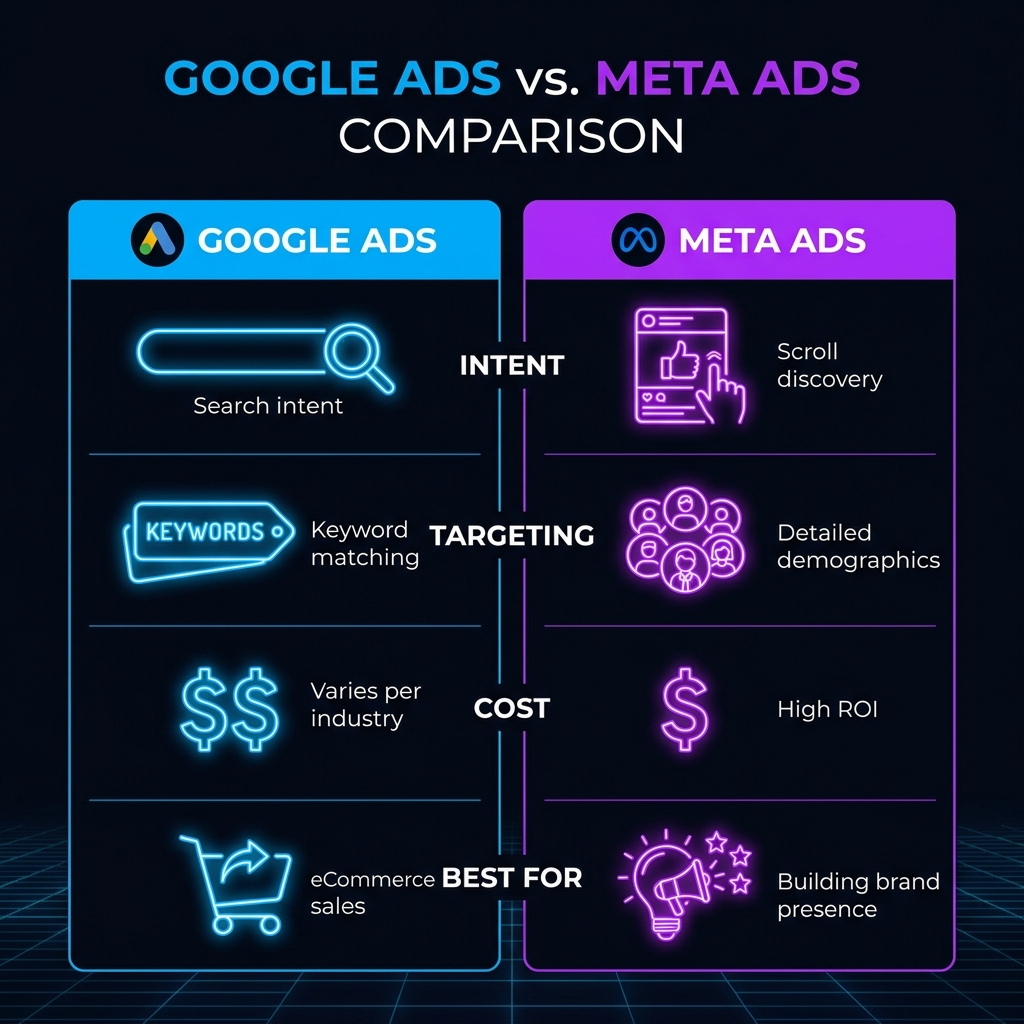
Google Ads vs Meta Ads – Key differences at a glance
Google Ads: Pros & Cons
[YES] Pros
- High intent traffic – Users are actively searching for what you offer
- Massive reach – Google processes 8.5 billion searches per day
- Diverse ad formats – Search, Display, Shopping, YouTube, PMax
- Precise keyword targeting – Bid on exact terms your customers search
- Immediate results – Ads can start generating clicks within hours
- Strong for local businesses – Google Maps and local search integration
[NO] Cons
- Higher CPC – Competitive industries can see CPCs of INR 200+
- Complex setup – Keyword research, negative keywords, bid strategies require expertise
- Click fraud risk – Competitors can click your ads (though Google has protections)
- Limited visual creativity – Search ads are text-only
- Steep learning curve – Managing campaigns effectively requires significant knowledge
Meta Ads: Pros & Cons
[YES] Pros
- Lower cost per click – Generally 40-60% cheaper than Google Ads
- Visual storytelling – Rich creative formats (Reels, Stories, Carousels)
- Advanced audience targeting – Interest-based, behavioural, and lookalike audiences
- Excellent for brand awareness – Reach millions of users who match your ideal profile
- Powerful retargeting – Meta Pixel tracks user behaviour for precision retargeting
- Social proof – Likes, comments, and shares build trust organically
[NO] Cons
- Lower purchase intent – Users aren’t actively looking to buy
- Algorithm dependency – Performance relies heavily on Meta’s AI
- Privacy changes impact – iOS updates have reduced tracking accuracy
- Ad fatigue – Creative needs frequent refreshing
- Platform dependency – Account bans or policy changes can disrupt campaigns
Which Platform Should You Choose?
The truth? It depends on your business goals, industry, and budget. Here’s a quick decision framework:

Choosing the right advertising platform for your business
Choose Google Ads if:
- [Search] People are actively searching for your product/service
- [Cart] You run an e-commerce store and want Shopping Ads
- [Location] You’re a local business (plumber, dentist, restaurant)
- [Budget] You want immediate, high-intent leads
- [Building] You have a higher advertising budget (CPC is higher)
Choose Meta Ads if:
- [Creative] Your product is visually appealing (fashion, food, lifestyle)
- [New] You’re launching a new brand and need awareness
- [Community] You want to build a community and engagement
- [Smaller Budget] You have a smaller budget and need lower CPCs
- [Target] You know your ideal customer demographics precisely
Use BOTH if:
- [Launch] You want full-funnel coverage (awareness -> consideration -> conversion)
- [Data] You have budget for both and want to maximize reach
- [Loop] You want to retarget across platforms (see your ad on Google AND Instagram)
- [Growth] You’re serious about scaling your business aggressively
The Ultimate Strategy: Using Both Together
The most successful advertisers in 2026 don’t choose one or the other – they use both platforms strategically:
- Top of Funnel (Awareness): Use Meta Ads with engaging video content to introduce your brand to cold audiences
- Middle of Funnel (Consideration): Retarget engaged users with Meta carousel ads showing product benefits and social proof
- Bottom of Funnel (Conversion): Use Google Search Ads to capture high-intent users who are now searching for your product by name
- Post-Purchase: Use Meta retargeting to upsell, cross-sell, and build loyalty
This full-funnel approach typically delivers 3-5x better ROI than using either platform alone.
Cost Comparison in India (2026)
| Metric | Google Ads | Meta Ads |
|---|---|---|
| Average CPC | INR 20-INR 200 | INR 5-INR 50 |
| Average CPM | INR 150-INR 500 | INR 80-INR 250 |
| Min Daily Budget | INR 500 | INR 100 |
| Recommended Monthly | INR 30,000+ | INR 15,000+ |
| Cost per Lead | INR 200-INR 1,500 | INR 50-INR 500 |
Note: Costs vary significantly by industry, competition, targeting, and ad quality.
Final Verdict
There’s no universal winner. Google Ads wins for high-intent, search-driven conversions. Meta Ads wins for visual storytelling, brand building, and cost efficiency.
The smartest strategy in 2026? Start with one, master it, then add the other.
- Limited budget? Start with Meta Ads for brand awareness, then add Google Ads for conversions.
- Service-based business? Start with Google Ads to capture searchers, then add Meta for retargeting.
- E-commerce? Use Google Shopping + Meta Dynamic Ads together from day one.
Need Expert Help?
At Grothify, we’ve managed 100+ campaigns across both Google Ads and Meta Ads, delivering 300-420% ROI for our clients. Whether you need help with one platform or a full-funnel strategy, we’ve got you covered.
-> Contact Grothify for a Free Consultation
Written by Mohammed Ouzair, Digital Marketing Specialist at Grothify. Follow us on Instagram and LinkedIn for daily marketing tips.