Choosing the wrong Google Ads bidding strategy can bleed your advertising budget in days. With automated Smart Bidding powered by Google AI, advertisers now have 8+ bidding options — each designed for specific business objectives, conversion volumes, and budget sizes.
At Grothify, optimizing bidding strategies is how we consistently achieve 400% to 900%+ ROAS for our PPC clients. In this guide, we break down every Google Ads bidding strategy in 2026, when to use each, and how to avoid costly bidding traps.
Wasting Spend on Wrong Bidding Strategies?
We’ll analyze your campaign bids, conversion signals & ROAS targets for free.
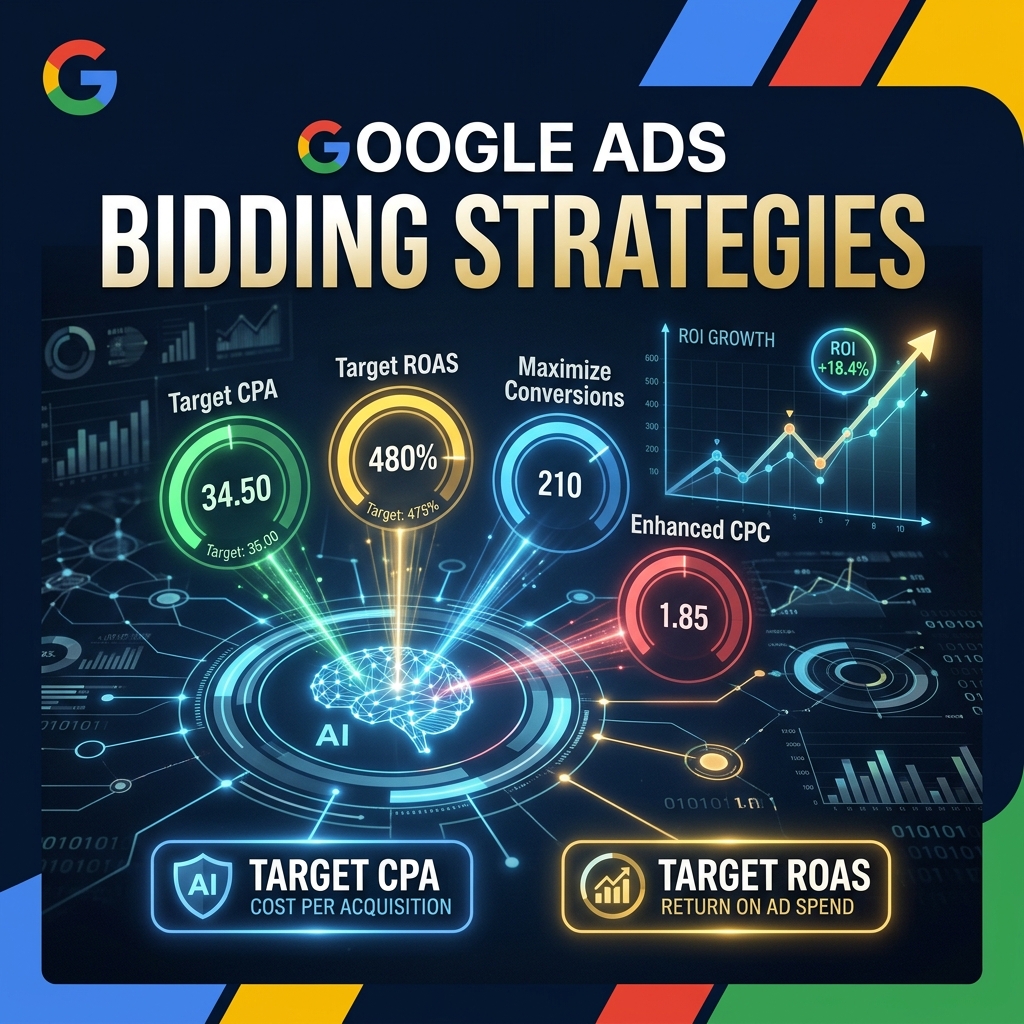
Overview of All Google Ads Bidding Strategies
| Bidding Strategy | Category | Primary Goal | Best Used For |
|---|---|---|---|
| Manual CPC | Manual | Complete control over bid price per click | New accounts, low budget, niche keywords |
| Enhanced CPC (ECPC) | Semi-Automated | Adjust manual bids based on conversion odds | Transitioning from manual to automated |
| Maximize Conversions | Smart Bidding | Get maximum conversion volume within budget | Lead gen campaigns with set daily budgets |
| Target CPA (tCPA) | Smart Bidding | Maintain a specific cost per conversion | Lead gen with established conversion data (30+/mo) |
| Maximize Conversion Value | Smart Bidding | Drive highest overall revenue value | E-commerce with variable cart values |
| Target ROAS (tROAS) | Smart Bidding | Hit a target Return on Ad Spend (e.g. 500%) | E-commerce stores scaling profitability |
| Target Impression Share | Automated | Dominate top of Google search results page | Brand protection, competitive defense |
1. Manual CPC Bidding
How it works: You manually set the maximum amount you are willing to pay for a click on each individual keyword.
Pros: Full control over costs. Prevents Google’s algorithm from overspending on low-converting terms.
Cons: Time-consuming; misses real-time contextual signals like device, time of day, user search history, and location micro-data.
When to use: Brand new campaigns with 0 conversion history, or low-volume niche campaigns under ₹500/day budget.
2. Maximize Conversions
How it works: Google uses machine learning to automatically set bids at auction time to fetch the highest number of conversions within your daily budget.
Pros: Fast data collection; highly effective for driving volume without setting strict cost targets initially.
3. Target CPA (Cost Per Acquisition)
How it works: You specify your target cost per lead (e.g. ₹500 per inquiry), and Google automatically bids higher or lower for users likely to convert at that cost.
Prerequisite: Minimum 30 conversions in the last 30 days for reliable algorithm training.
Pro Tip: Pair Target CPA optimizations with Quality Score improvements (see our Quality Score guide) to dramatically decrease your actual CPA.
4. Target ROAS (Return On Ad Spend)
How it works: Designed specifically for e-commerce. You define your target return (e.g., 400% ROAS = ₹4 revenue for every ₹1 spent). Google bids dynamically based on predicted order value.
How to Choose the Right Strategy (Decision Flowchart)
- New Campaign / No Historical Data? → Start with Manual CPC or Maximize Conversions.
- Lead Gen with 30+ Monthly Leads? → Switch to Target CPA.
- E-Commerce Store with Revenue Tracking? → Use Target ROAS.
- Defending Your Brand Name? → Use Target Impression Share (90%+ Top of Page).
Get Expert PPC Bidding Management
Grothify manages Google Ads campaigns with custom AI bidding rules & real-time ROAS tracking.
Frequently Asked Questions
How long does the Google Ads Smart Bidding learning phase take?
The learning phase typically lasts 7 to 14 days after changing bidding strategies. During this period, avoid making major adjustments to bids, budgets, or ad copy.
Why did my conversion volume drop after switching to Target CPA?
If your Target CPA is set too low (e.g. set to ₹200 when your historical average is ₹600), Google will stop bidding in competitive auctions, choking off impression volume. Set your initial tCPA slightly above your 30-day historical average and lower it gradually by 10% per week.
Written by Mohammed Ouzair, Google Ads Certified Specialist & Founder of Grothify. Part of our Google Ads services. Follow on Instagram and LinkedIn.